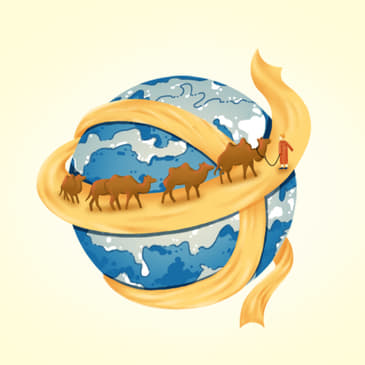
Chapter 1:What is The Silk Roads book about
"The Silk Roads" is a non-fiction book written by Peter Frankopan. It explores the historical development and significance of the ancient trade routes known as the Silk Road. The book takes a comprehensive approach, spanning over 2,000 years of history and focusing on the interactions between different civilizations along these routes.
Rather than solely focusing on the economic aspects of the Silk Road, Frankopan delves into the political, cultural, and social impacts as well. He argues that the Silk Road was not just a trade network but also a conduit for the exchange of ideas, religions, technologies, and knowledge between East and West.
Frankopan's narrative provides a fresh perspective on world history, highlighting the pivotal role played by Central Asia and the Middle East in connecting Europe, Africa, and Asia. He discusses the rise and fall of different empires, the movement of goods and people, the spread of religions like Buddhism and Islam, and the transformative effects of trade on societies.
The book sheds light on lesser-known events and figures, challenging the Eurocentric view of history and offering a broader understanding of the global interconnectedness shaped by the Silk Road. Overall, "The Silk Roads" presents a captivating journey through time, exploring the complex web of connections forged along these ancient routes.
Chapter 2:Why is The Silk Roads a best-selling book
Unique Perspective: The book offers a fresh and unique perspective on world history by focusing on the interconnectedness of cultures along the ancient Silk Roads. This approach sheds light on lesser-known historical events and provides a comprehensive understanding of how different civilizations influenced each other.
Timely Relevance: The concept of the Silk Roads resonates with contemporary society, as it underscores the importance of global connections and trade networks. In today's increasingly interconnected world, people are eager to learn about the historical roots of globalization and cultural exchange.
Engaging Writing Style: Peter Frankopan, the author of The Silk Roads, has a captivating writing style that combines scholarly research with storytelling. He seamlessly weaves together historical facts, personal anecdotes, and vivid descriptions, making the book accessible and engaging for a broad range of readers.
Broad Scope: The book covers a vast geographical area, spanning from China to Europe, and from India to the Middle East. By encompassing such a broad scope, The Silk Roads appeals to readers interested in various regions and civilizations, providing a comprehensive overview of interconnected histories.
Academic Rigor: Despite its accessibility, The Silk Roads maintains a high level of academic rigor. Frankopan draws on extensive research, citing a wide range of primary and secondary sources to support his arguments. As a result, the book is well-regarded within both scholarly and general audiences.
Critical Acclaim and Reviews: The Silk Roads received positive reviews from critics, which further boosted its popularity. Positive word-of-mouth recommendations, combined with endorsements and recognition from reputable sources, helped propel the book's success.
In summary, The Silk Roads' unique perspective, timely relevance, engaging writing style, broad scope, academic rigor, and critical acclaim all contribute to its status as a best-selling book.
Chapter 3: The Silk Roads plot
"The Silk Roads" is a historical non-fiction book written by Peter Frankopan. It explores the complex history of the world through the lens of the ancient trade routes known as the Silk Road. The book covers a vast period, starting from the rise of the Persian Empire and continuing through to the present day.
The plot of "The Silk Roads" focuses on the interconnectedness of different regions and civilizations throughout history. It delves into the economic, political, and cultural exchanges that took place along these trade routes, which stretched across Asia, Europe, Africa, and the Middle East.
The book begins by discussing the importance of Central Asia in the development of the Silk Roads and explores how this region shaped the interactions between empires, such as the Roman, Byzantine, Mongol, and Ottoman Empires. It also examines the role of religion, particularly the spread of Buddhism, Islam, and Christianity along the Silk Roads.
Frankopan highlights the impact of significant events, including the fall of the Roman Empire, the rise of Islam, the Crusades, the Mongol conquests, and the discovery of the Americas. He demonstrates how these events altered the balance of power and influenced the flow of goods, ideas, and knowledge along the Silk Roads.
Additionally, the author explores the European Age of Discovery and the subsequent colonization of Asia by Western powers. He emphasizes how these colonial powers exploited the resources of Asian countries and reshaped political and economic landscapes, ultimately leading to the decline of the Silk Roads as a major trading network.
"The Silk Roads" also discusses contemporary global dynamics and the resurgence of Asia in the 21st century. It analyzes China's Belt and Road Initiative, which seeks to revive ancient trade routes and enhance connectivity across Eurasia. The book reflects on the potential consequences and challenges of this renewed focus on international trade.
Overall, "The Silk Roads" presents a comprehensive narrative of world history, highlighting the pivotal role of the Silk Roads in shaping our global civilization. It explores the diverse cultures, conflicts, and exchanges that occurred along these trade routes, ultimately providing a deeper understanding of our interconnected world.