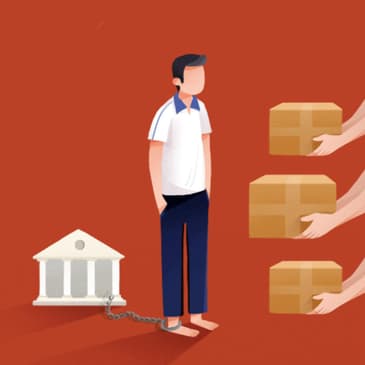
"Free to Choose" is a book written by Milton Friedman, an economist, and his wife Rose Friedman. The book aims to explain the benefits of free-market capitalism and advocate for limited government intervention in economic affairs.
The Friedmans argue that economic freedom enables individuals to pursue their own self-interests, resulting in voluntary exchange and the creation of wealth. They emphasize that economic freedom is essential for political freedom and individual liberties, as it allows people to make choices without coercion or interference from the state.
The book analyzes various economic issues, such as government regulation, taxation, education, welfare, and equality. The Friedmans argue that government intervention often leads to unintended consequences, such as higher costs, bureaucratic inefficiency, and reduced individual freedom.
They advocate for policies that limit government interference in the economy, such as reducing regulations, lowering taxes, and promoting free trade. They also argue that individuals should be responsible for their own well-being, with limited government assistance only for those truly in need.
Furthermore, the Friedmans discuss the importance of education in promoting economic and social progress. They argue for the decentralization of education, giving parents the power to choose the education that best suits their children and promoting competition among schools.
In conclusion, "Free to Choose" is a passionate defense of free-market capitalism and individual liberty. The Friedmans provide a compelling argument for limited government intervention in economic affairs, advocating for policies that promote economic freedom and individual choice.
Chapter 2:the meaning of Free To Choose book"Free To Choose" is a book written by economist Milton Friedman and his wife Rose Friedman. It was published in 1980 and serves as a manifesto for economic and political freedom.
The central theme of "Free To Choose" revolves around the belief that individuals should have the freedom to make economic decisions without interference or coercion from the government. The book passionately argues in favor of the principles of free markets, limited government intervention, and individual liberty as the foundation for economic prosperity and personal freedom.
The Friedmans strongly advocate for free-market capitalism as a means to achieve economic growth, innovation, and progress. They argue that when individuals are free to pursue their own interests and engage in voluntary exchange, it leads to the most efficient allocation of resources and the greatest overall benefit for society.
Throughout the book, the Friedmans discuss various economic concepts and policies, ranging from the implications of government regulation and intervention, the importance of competition in driving economic efficiency, the negative consequences of excessive taxation, and the value of individual choice and responsibility.
"Free To Choose" also delves into the implications of economic freedom on broader political and social issues. The Friedmans argue that a society with limited government interference not only achieves economic prosperity but also promotes personal freedom, political stability, and social harmony.
Overall, "Free To Choose" espouses Milton Friedman's libertarian views on economics and emphasizes the importance of individual freedom and limited government intervention in economic affairs. The book gained significant popularity and helped shape conservative economic thought in the United States and beyond.
Chapter 3:Free To Choose book chaptersChapter 1: The Power of the Market
In this chapter, Milton Friedman introduces the concept of the free market and its inherent power. He argues that voluntary transactions in the marketplace, where individuals pursue their own self-interest, lead to the most efficient allocation of resources and the highest level of satisfaction for individuals in society.
Chapter 2: The Tyranny of Controls
Friedman discusses the negative consequences of government intervention in the economy. He argues that government regulations and controls often result in unintended consequences, including higher prices, decreased quality, and reduced individual freedom.
Chapter 3: Anatomy of Crisis
This chapter explores the causes and effects of economic crises. Friedman argues that most crises are caused by excessive government intervention, such as inflationary monetary policies and excessive regulation. He suggests that a free market system provides a better mechanism for preventing and resolving economic crises.
Chapter 4: Cradle to Grave
Friedman examines the increasing role of government in providing welfare and social security programs. He argues that these programs, while initially well-intentioned, create dependency and reduce individual incentives to work and save. He suggests alternative approaches, such as voluntary charity and privatized social security, that he believes would be more effective.
Chapter 5: Created Equal
In this chapter, Friedman analyzes the concept of equality and the role of government in promoting it. He argues that equality of opportunity is a desirable goal, but that attempts to achieve equality of outcomes through government intervention are misguided and result in the suppression of individual liberty and economic growth.
Chapter 6: What's Wrong with Our Schools?
Friedman critiques the government-run education system and argues in favor of a voucher system. He contends that competition among schools, enabled by vouchers, would lead to better quality education and increased choice for parents.
Chapter 7: Who Protects the Consumer?
Friedman discusses the role of government in protecting consumers. He argues that market competition and individual choices are sufficient to protect consumers from unsafe and low-quality products. He suggests that government intervention often benefits special interest groups rather than consumers.
Chapter 8: Who Protects the Worker?
In this chapter, Friedman examines the role of labor unions and government regulations in protecting workers. He argues that unions can sometimes harm workers' interests by reducing job opportunities and impeding economic growth. He advocates for voluntary associations and competitive labor markets as more effective means of protecting workers.
Chapter 9: The Cure for Inflation
Friedman proposes a monetary policy based on a fixed rule to combat inflation. He argues that discretionary monetary policies can lead to economic instability and recommends a steady increase in the money supply to support long-term economic growth.
Chapter 10: The Tide Is Turning
The final chapter of the book discusses the changing attitudes towards free market principles. Friedman highlights the growing skepticism towards government intervention and the increasing recognition of the benefits of free markets. He concludes by expressing his optimism for the future of economic freedom.
Chapter 4: Quotes of Free To Choose book- "The power to do good is also the power to do harm; those who control power today may not tomorrow; and, more important, what one person considers good, another may consider harm."
- "The great advances of civilization, whether in architecture or painting, in science or literature, in industry or agriculture, have never come from centralized government."
- "There is no solution to poverty except through individual freedom and voluntary exchange."
- "The society that puts equality before freedom will end up with neither. The society that puts freedom before equality will end up with a great measure of both."
- "Underlying most arguments against the free market is a lack of belief in freedom itself."
- "The only way that has ever been discovered to have a lot of people cooperate together voluntarily is through the free market."
- "The great virtue of a free market system is that it does not care what color people are; it does not care what their religion is; it only cares whether they can produce something you want to buy."
- "Inflation is always and everywhere a monetary phenomenon."
- "One of the great mistakes is to judge policies and programs by their intentions rather than their results."
- "The most important single central fact about a free market is that no exchange takes place unless both parties benefit."
[00:00:00] Hi, welcome to Bookie, which unlock big ideas from world best sellers and audio,
[00:00:05] text, and mind map. Please download Bookie at Apple Store or Google Play with more features.
[00:00:11] Get your free mind snack now. Today we will unlock the book free to choose.
[00:00:17] In the 19th century, under the dominance of the market economic system,
[00:00:22] America experienced rapid economic development through marketians. People started to question, does government intervention really promote social prosperity
[00:01:40] and improve social welfare?
[00:01:42] Does it bring damage?
[00:01:44] This book for you to choose will answer these questions for you. 1980 was hailed as one of the most popular economics books ever written. With more than a million copies sold worldwide, it is one of a few economics books that uses simple language and riveting cases to explain its content. Although it was written many years ago, it is still a useful reference for modern societies.
[00:03:00] We will unlock this book in three parts.
[00:03:03] Part 1.
[00:03:04] How the Free Market Works. only produce the wooden part of the pencil. To make an entire pencil, we also need the writing core lead, made of graphite from salon, now Sri Lanka, and the eraser. The eraser is a product of a chemical reaction between sulfur chloride and rapeseed oil from the Dutch East Indies, now Indonesia.
[00:04:20] Apart from that, each link requires different them from working together to produce a pencil. What is more surprising is that during the whole process, no one's sitting in a central office gave orders to these thousands of people. This is the way Friedman introduces the way in which a free market operates, people cooperating
[00:05:41] through voluntary exchange. As early as around 200 years ago, Adam Smith stated in the wealth manufacturers realize that maintaining the previous output is not sensible, unless the pencil's price is higher than before. Due to the fire, the demand for the pencil starts to thus exceed the supply, making the price rise. Consumers who do not want to spend more money, either use pencils as much as possible before discarding them, or simply switch to using a mechanical pencil.
[00:07:03] Thus, consumers do not need to know why pencils become more economically. This is how the price change provides incentive to producers and consumers. Finally, let's take a look at the third function of the price system, distributing income. The net profit of the manufacturer for selling pencils is the revenue left after subtracting wages, rent, and other production factors. Therefore, the manufacturer's revenue is determined by
[00:08:24] the factors of production they own and the market price of the factors of production.
[00:09:25] it, people can exchange voluntarily and cooperate with each other. Now that we understand the function of the price system in a free market and how pricing
[00:09:29] works, let's talk about what role the government should play in a free market.
[00:09:34] Based on Adam Smith's ideas, Friedman came up with four duties of the government.
[00:09:39] First, the duty of protecting the society from the violence and invasion of other independent
[00:09:45] societies. Certain public works and public institutions exist mainly to tackle issues that are not profitable for individuals, but beneficial to society. To take one simple example suggested directly by Smith's description of the third duty, city streets and general access highways could be provided by private voluntary exchange,
[00:11:00] the cost being paid for by charging tolls.
[00:11:03] But the costs of collecting the tolls would, the United Kingdom, and the United States, which made tremendous achievements
[00:12:23] under limited government. India had more well-trained public sector workers, modern factories, and a high-quality railway system. But these did not exist in Japan. India's natural resources were superior to those of Japan, which relied on the ocean. India had been receiving international assistance, while Japan only counted on itself.
[00:13:41] Given these differences, India had a clear advantage over Japan. of various fields, and protected those with vested interests from being affected. This eventually led to economic inefficiency and economic privilege, with national creativity being also severely dampened. Although the two leaders had the same goal, their adopted policies were different, which caused completely different results. Friedman tells us through this example that only when
[00:15:04] the government plays a limited role in maintaining the free market, can a country-inspired national