Chapter 1:what is the Amusing Ourselves To Death about
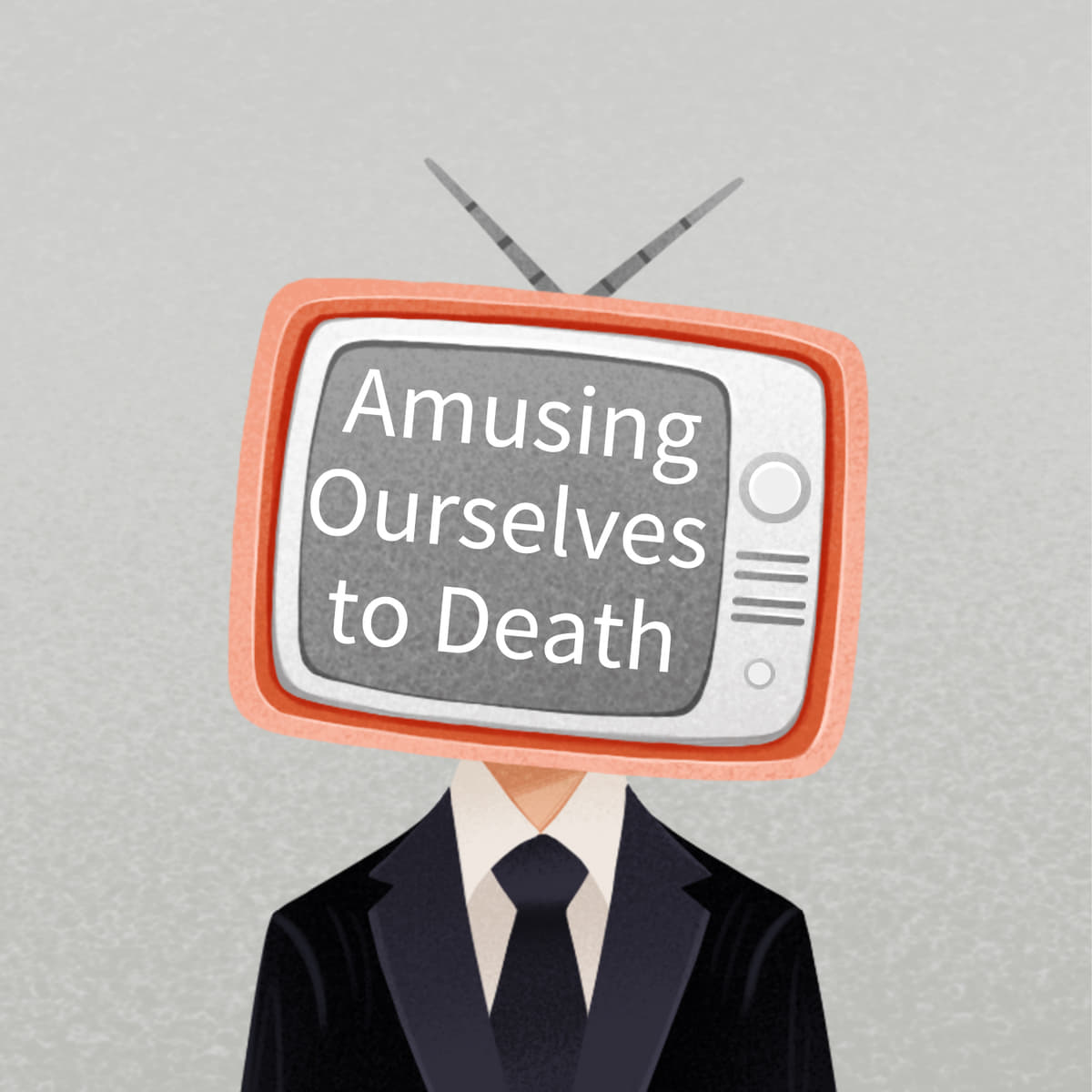
"Amusing Ourselves to Death: Public Discourse in the Age of Show Business" is a book written by Neil Postman. In this book, Postman argues that the way information is presented and consumed in modern society is fundamentally altering our ability to think critically, engage in meaningful discourse, and comprehend complex ideas.
Postman starts by comparing the dystopian visions presented by George Orwell in "1984" and Aldous Huxley in "Brave New World." While Orwell feared that we would be controlled by an oppressive government forcibly imposing their will on us, Postman argues that Huxley's prediction is closer to the truth. According to Postman, we are not being controlled by an external force, but rather by our own addiction to entertainment and trivial distraction.
Postman explores the history of communication technologies, highlighting the shift from a print-based culture to one dominated by television and visual images. He argues that television, with its focus on entertainment and sound bites, has shaped our public discourse, diminishing our attention span and critical thinking abilities. Postman suggests that television encourages a culture that values style over substance, where serious issues are reduced to superficial sound bites and emotional appeals.
The book also discusses the decline of the written word and the rise of visual imagery as the primary tool for conveying information. Postman claims that television's influence has transformed politics, education, and even religion. He argues that our culture has become one of entertainment, resulting in a society that prioritizes amusement and instant gratification over reflection and intellectual engagement.
Postman concludes by suggesting ways to combat the negative effects of television and the decline of serious discourse. He advocates for increased media literacy, a renewed emphasis on critical thinking skills, and a return to a culture that values substantial content over entertainment value.
"Amusing Ourselves to Death" is a thought-provoking critique of modern society's reliance on entertainment and its impact on intellectual and cultural life. The book warns against the dangers of mindless consumption of information and encourages readers to actively engage with the world around them.
Chapter 2:Author of the Amusing Ourselves To Death
Neil Postman (1931-2003) was an American cultural critic, media theorist, and author known for his insightful analysis of the impact of media and technology on society. He is perhaps best known for his book "Amusing Ourselves to Death: Public Discourse in the Age of Show Business," published in 1985.
In "Amusing Ourselves to Death," Postman presents a thought-provoking argument that the rise of television and the entertainment-centric culture it promotes has had a detrimental effect on public discourse and our ability to think critically. He argues that television, with its emphasis on short attention spans, visual imagery, and entertainment value, has reduced public discourse to mere amusement, rendering serious issues shallow and trivial.
Postman explores the historical context of media and its impact on society, drawing comparisons between the earlier era of the printed word and the modern era of television. He suggests that while print media encouraged rational and intellectual thinking, television viewers have become passive consumers of fragmented information, lacking depth and understanding. Postman further argues that the shift from a print-based culture to a visual culture has had profound consequences on politics, education, news, and even our personal lives.
Throughout his career, Neil Postman authored numerous other books, including "Technopoly: The Surrender of Culture to Technology" and "The Disappearance of Childhood." He also wrote extensively on various topics related to media, communication, and education. Postman's work continues to be influential in media and communication studies, prompting readers to critically examine the impact of media on society and the choices we make as consumers of information.
Neil Postman's profound insights and critique of modern media landscape make him a highly regarded figure in the field. His writings encourage readers to reflect on the way media influences our perception, thinking, and social interactions in an age dominated by technology and entertainment.
Chapter 3:why is the Amusing Ourselves To Death worth reading
Amusing Ourselves To Death by Neil Postman is considered a thought-provoking and influential book for several reasons:
- Analysis of the impact of media: Postman explores how the rise of television and other forms of media has profoundly affected public discourse and the way we perceive information. He argues that media shapes not only what we think about but also how we think.
- Historical context: The book provides a historical perspective by comparing the print age with the television age. It delves into how the transition from a text-based culture to a visually-driven culture has altered our ability to engage in deep, critical thinking and meaningful discussion.
- Insightful critique of television culture: Postman identifies the dangers of a society that prioritizes entertainment and spectacle over substantive content. He argues that the prevalence of trivia, sensationalism, and the demand for constant amusement has led to a trivialization of public discourse.
- Communication theory: The book draws upon communication theories to explain how media influences our understanding of reality. Postman highlights the role of media in shaping our perception of truth, knowledge, and our capacity to engage in meaningful conversations.
- Relevance in the digital age: While the book was written in the 1980s, many of its arguments are still applicable today, especially in the era of the internet, social media, and the proliferation of digital information. It prompts readers to reflect on the current media landscape and its impact on society.
- Engaging and accessible style: Postman's writing style is clear, concise, and accessible, making complex ideas easy to understand. He uses a mix of scholarly research, historical examples, and anecdotes to illustrate his points, making it engaging for a wide range of readers.
Overall, Amusing Ourselves To Death stands out as a compelling and insightful critique of modern media culture, provoking readers to reflect critically on how media shapes their worldview and the importance of maintaining a balance between entertainment and meaningful discourse.
Chapter 4: Books like the Amusing Ourselves To Death
- "The Shallows: What the Internet Is Doing to Our Brains" by Nicholas Carr: This book explores how the internet is shaping our thinking processes and argues that it is diminishing our ability to concentrate and think deeply.
- "Deep Work: Rules for Focused Success in a Distracted World" by Cal Newport: Similar to Postman's concerns about distractions and shallow thinking, this book presents strategies for cultivating a focused and productive work environment in the digital age.
- "The Filter Bubble: What the Internet Is Hiding from You" by Eli Pariser: This book examines the personalization algorithms used by internet platforms, which create an echo chamber effect and limit exposure to diverse viewpoints.
- "Weapons of Math Destruction: How Big Data Increases Inequality and Threatens Democracy" by Cathy O'Neil: In this book, O'Neil explores the influence of algorithms in shaping our society, highlighting how they can reinforce biases and create harmful disparities.
- "Digital Minimalism: Choosing a Focused Life in a Noisy World" by Cal Newport: This book offers practical guidance on how to step back from technology overload and regain control over one's attention and time.
- "The Age of Surveillance Capitalism: The Fight for a Human Future at the New Frontier of Power" by Shoshana Zuboff: In this book, Zuboff examines the power dynamics and societal implications of surveillance capitalism, where personal data is commodified in the digital economy.
- "The Attention Merchants: The Epic Scramble to Get Inside Our Heads" by Tim Wu: Wu explores the history and evolution of attention-grabbing industries, from the early days of advertising to the current era of social media and digital distractions.
- "The Dumbest Generation: How the Digital Age Stupefies Young Americans and Jeopardizes Our Future (Or, Don't Trust Anyone Under 30)" by Mark Bauerlein: This book discusses concerns about the intellectual and social implications of the digital age on younger generations and their ability to engage with complex ideas.
- "The Internet of Us: Knowing More and Understanding Less in the Age of Big Data" by Michael Lynch: Lynch explores how the abundance of information available on the internet can actually hinder our ability to acquire true knowledge and deepen our understanding of the world.
- "Ten Arguments for Deleting Your Social Media Accounts Right Now" by Jaron Lanier: Lanier presents compelling arguments for why individuals should consider disconnecting from social media platforms, pointing out the negative effects they can have on mental health, society, and democracy.