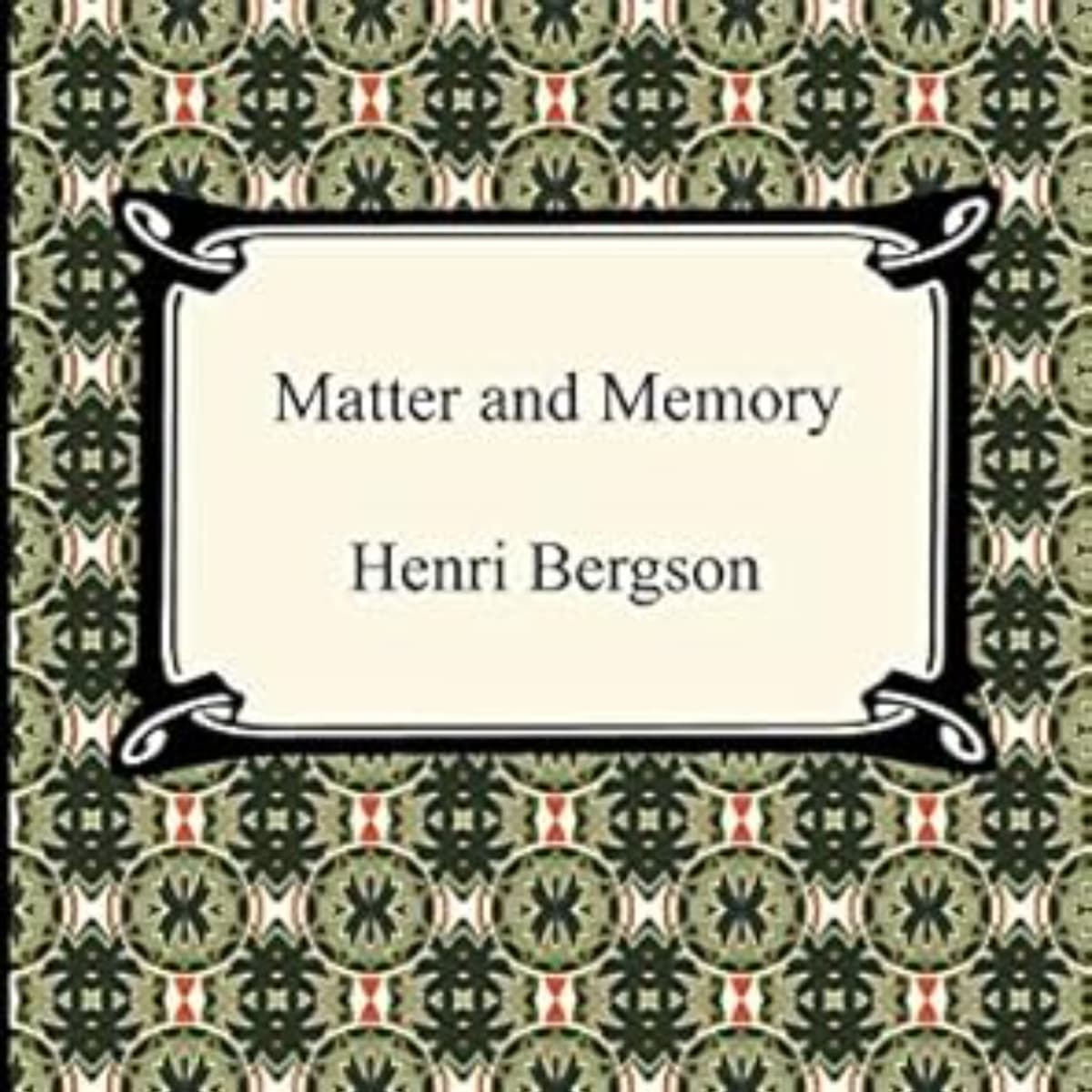
In a quaint Parisian café, an old philosopher named Henri sat, tracing the lines of his thoughts on a napkin. He pondered the intricate dance between matter and memory, revealing that our experiences are not mere shadows of the past but vibrant threads woven into our being.
He spoke of how memories shape our perceptions, allowing us to live not just in the now, but in a tapestry of time where each moment is alive with meaning. Bergson argued that while matter is rigid and static, memory flows like a river, constantly reshaping the landscape of our minds.
As he sipped his espresso, he realized that understanding this relationship could unlock the door to deeper consciousness—a reminder that we are not just specters of our past but architects of our future. In the intermingling of matter and memory, we find the essence of what it truly means to be alive.
Chapter 1:What Is Matter and Memory
"Matter and Memory" by Henri Bergson, published in 1896, is a philosophical work that explores the relationship between matter, perception, and memory. It is considered one of Bergson's major works and offers insights into the nature of consciousness, time, and the experience of reality.
Evaluation Criteria:
1. Depth and Accuracy of Content:
- Bergson provides a deep analysis of the relationship between memory and perception, emphasizing the distinction between "pure perception" and "memory-images." His insights align well with later considerations in cognitive science and philosophy, though some of his conclusions may be viewed as speculative today.
2. Originality:
- The book is highly original, presenting a novel perspective on time and experience, challenging the mechanistic views prevalent in his time. Bergson's ideas about the fluidity of time and spontaneity in memory marked a departure from earlier philosophical thought.
3. Organization:
- The structure of the work can be seen as somewhat complex, reflecting the intricate nature of his ideas. While it is logically organized, readers may find some sections dense, which can affect overall comprehension.
4. Readability:
- The writing style is philosophical and can be challenging for those unfamiliar with such discourse. Some readers may find his prose elegantly flowing, while others might struggle with abstract concepts.
5. Inspirational Emotional Impact:
- Bergson's exploration of memory and its connection to existence can be quite moving, encouraging readers to reflect on their own experiences of time and consciousness. His philosophy is often seen as liberating, invoking a sense of the richness of life.
6. Cultural and Social Impact:
- "Matter and Memory" has influenced various fields, including psychology, art, and literature. Bergson’s ideas contributed to the development of modern philosophy and have had lasting impacts on discussions of consciousness and perception.
7. Attention to Detail:
- Bergson demonstrates a strong attention to detail in dissecting complex concepts such as intuition and intellect, memory, and the nature of perception. His careful consideration gives depth to his arguments.
8. Theme and Message:
- Central themes include the interplay between memory and perception, the nature of time, and the concept of duration (la durée). The message emphasizes the importance of subjective experience over objective measurement.
9. Critical Thinking:
- Bergson encourages readers to think critically about the nature of reality and perception and to question traditional philosophical dichotomies. His arguments stimulate further inquiry and debate on the nature of consciousness.
10. References:
- While "Matter and Memory" contains references to other works, it predominantly relies on Bergson's original thought rather than extensive citations, which may limit scholarly comparison yet emphasizes his unique perspective.
11. Creativity and Artistry:
- Bergson's philosophical exploration is both creative and artistic in its formulation. He uses metaphors and vivid imagery to convey complex ideas, illustrating the intertwining of philosophy and literary artistry.
Conclusion:
"Matter and Memory" is a significant philosophical text that invites deep reflection and discussion. While it may pose challenges in readability and organization for some, its originality, depth, emotional resonance, and cultural impact establish it as a profound work in understanding consciousness and experience. For those interested in philosophy, psychology, and the nature of reality, it remains an essential and inspiring read.

Chapter 2:Matter and Memory chapters
"Matter and Memory" is a philosophical work by Henri Bergson, first published in 1896. In this book, Bergson explores the relationship between matter, memory, and perception, and how these concepts relate to the experience of time and consciousness. Here’s a brief summary of the key chapters:
Introduction
Bergson introduces the primary thesis of the book, which revolves around understanding how memory interacts with physical reality. He challenges traditional dualistic views that separate mind and matter, suggesting instead a more integrated approach involving both.
Chapter 1: The Problem of Memory
Bergson discusses the nature of memory, making distinctions between the physical brain and the experience of remembering. He distinguishes between recollection and habit, emphasizing how memory is not merely a storehouse of past experiences but an active process that informs our perception of the present.
Chapter 2: The Relation of Memory to the Past
Here, Bergson examines how memories form and their connection to the past. He introduces the idea of "pure memory," which exists independently of the brain's physical mechanisms. This chapter emphasizes the distinction between the past as a real objective memory and our current perception of it.
Chapter 3: Memory and Perception
Bergson argues that memory influences perception significantly. He suggests that when we perceive an object, we do not only engage with the material aspect but also bring forth associations and memories linked to that object, thereby enriching our experiences.
Chapter 4: Matter and Spirit
In this chapter, Bergson continues to explore the relationship between matter (the physical world) and spirit (the realm of consciousness). He critiques the scientific materialism of his time, arguing that reducing consciousness to mere brain activity fails to encapsulate the dynamism of life and experience.
Chapter 5: The Duration of Consciousness
Bergson introduces his famous concept of "duration" (la durée), contrasting it with the mathematical concept of time. He argues that real time, as experienced by consciousness, is qualitative and fluid rather than quantitative and static.
Chapter 6: The Synthesis of Memory and Perception
In the final chapters, Bergson seeks to reconcile memory and perception into a coherent framework. He presents a synthesis that emphasizes how both elements contribute to the fluid nature of experience, pushing against the rigid categorizations employed in scientific discourse.
Conclusion
Bergson concludes by reiterating the importance of understanding consciousness as an evolving and dynamic process. He encourages a view of reality that embraces change, fluidity, and the interconnectedness of matter and memory as foundational to human experience.
Overall Themes
Throughout "Matter and Memory," Bergson emphasizes the importance of consciousness, the interplay of past experiences with present perceptions, and the fluidity of time. His work is pivotal in the evolution of philosophy and psychology, especially in the context of existentialist and phenomenological thought.
This summary captures the core themes of "Matter and Memory." If you need more detailed summaries or points on specific chapters, please let me know!
In the heart of a bustling city, where the streets thrummed with the pulse of life, there lived an old watchmaker named Mr. Alaric. He was renowned for his ability to mend timepieces that seemed beyond repair, yet no one knew he carried a secret deeper than his craft. Each tick of his instruments resonated with the rhythm of a profound thought: a notion borrowed from a long-forgotten philosopher named Henri Bergson.
One misty evening, as the cobblestones glistened under a forgiving rain, a curious young girl named Lila peeked through the window of his shop. She was a dreamer, her mind woven with fanciful threads of imagination, yet she often found herself troubled by the relentless march of time. She had seen her mother’s smile fade like an old photograph and her childhood dreams shift like sand through her fingers.
“Come in, my dear,” Mr. Alaric beckoned, his voice like the soft shimmering of a distant bell. “What brings you here on such a dreary night?”
“I want to understand time,” Lila confessed, her voice barely above a whisper. “Why does it feel like memories slip away just as you reach for them?”
With a knowing smile, Mr. Alaric led her to a cluttered workbench brimming with clocks, each tick-tocking in cosmic harmony. “Ah, you remind me of Bergson,” he chuckled softly, settling on a stool beside her. “Allow me to share the essence of his thoughts through an ancient analogy.”
Lila leaned closer, her eyes wide with curiosity. “Bergson believed in two kinds of time,” he began, his fingers playing with a delicate gear. “One is measured by clocks, mechanical time, where every second is a mere quantification—rigid and unyielding. It’s the time that society insists we obey, but it fails to capture the full richness of our experience.”
He paused, as if each word he spoke shimmered like the glint of polished brass, and then he continued, “The other is what Bergson termed ‘duration’—a flowing, living experience that immerses us in the present. It’s like the way you feel when you are lost in a story, or when you play with a friend until the sunset kisses the horizon. It’s the depth of your emotions, the texture of your perceptions; it’s the essence of who we are beyond mere ticks of the clock.”
Lila’s brow furrowed, trying to grasp this philosophical duality. “So, while the clocks measure the hours, our memories shape our lives?”
“Exactly!” Mr. Alaric exclaimed, his eyes sparkling like distant stars. “Bergson argued that memory is not merely a record of the past; it intertwines with our consciousness, coloring our present and guiding our future. Think of it as a river, where moments flow and are forever changing, but always remaining part of the whole.”
As he spoke, he pointed to a small, exquisite hourglass on the shelf—a family heirloom, passed down through generations. “This glass captures time in its own dance. The grains of sand trickle down, yet they are never the same. Every moment that passes is unique, carrying with it everything we’ve built from our memories. Some are cherished; others are painful, yet each has its place in the tapestry of our lives.”
Lila’s heart swelled with understanding, and a smile broke across her face. “So, even though I might forget some moments, they all contribute to who I am! Time isn’t just something that passes; it’s a part of me!”
“Precisely!” said Mr. Alaric, delighted to see the light in her eyes. “Every tick of a clock marks not just a moment gone, but a thread pulled in the intricate weave of your existence. Remember, while the world may chase after the rigid notion of time, the essence of life lies in those fleeting flowing moments, the duration where we live, love, and remember.”
As Lila stepped out of the shop, the rain had ceased, and the moon hung like a silver pendant in the night sky. She felt a transformation within her—a newfound appreciation for the richness of her experience, for the imperfections that made her story uniquely hers.
In her heart, she carried the wisdom of Bergson, knowing that memories and moments interlaced to form the symphony of life. And with each step she took, she embraced the journey, where time itself became an ally in the unfolding story of who she was becoming.
Book https://www.bookey.app/book/matter-and-memory
Author https://www.bookey.app/quote-author/henri-bergson
Quotes https://www.bookey.app/book/matter-and-memory/quote
Suggested
Youtube https://www.youtube.com/watch?v=byQjq-9Zbzc
Amazon https://www.amazon.com/Matter-Memory-Henri-Louis-Bergson/dp/1420937804
Goodreads https://www.goodreads.com/book/show/865540.Matter_and_Memory