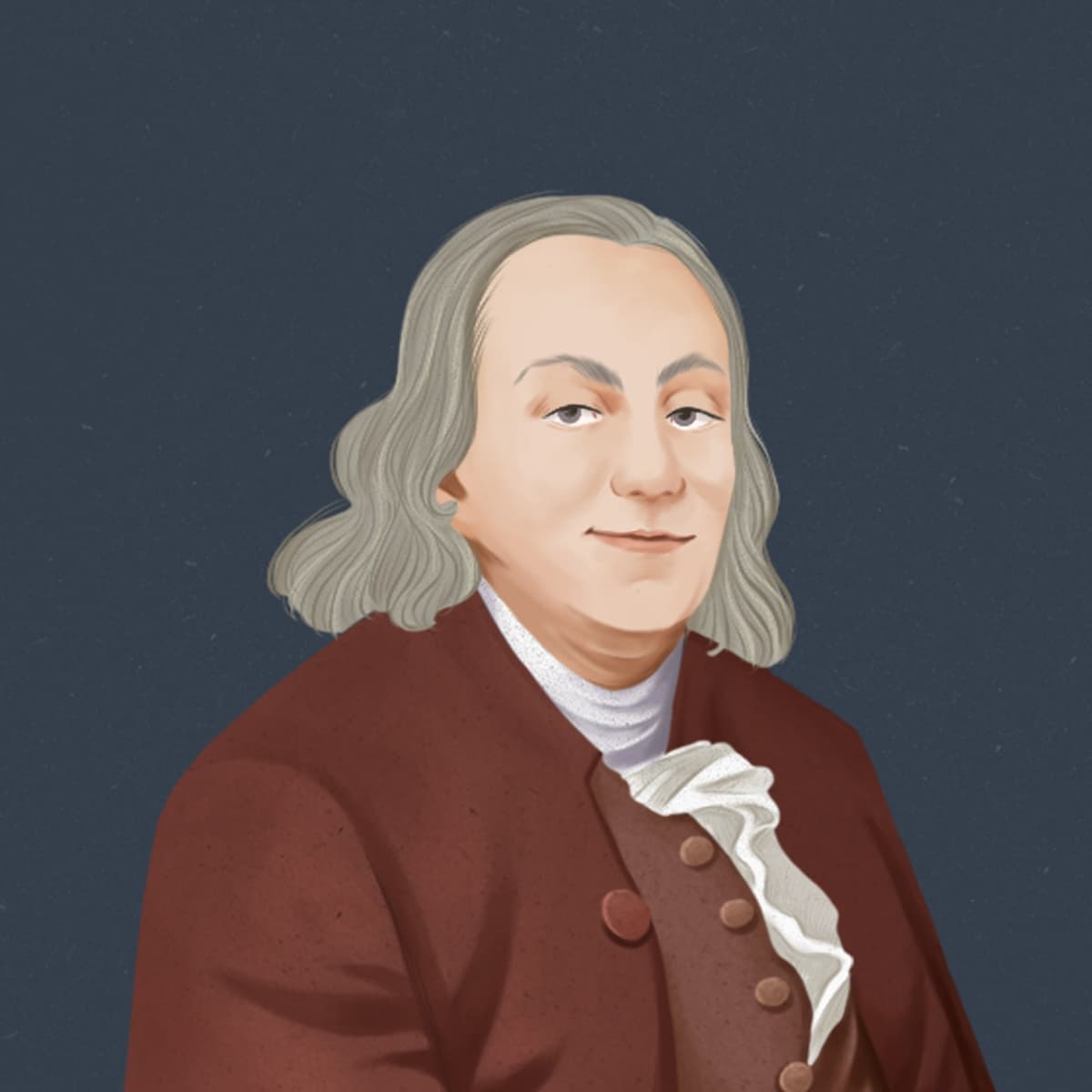
Chapter 1:Summary of the Benjamin Franklin
The book "Benjamin Franklin: An American Life" by Walter Isaacson is a comprehensive biography of one of America's most iconic founding fathers, Benjamin Franklin. Isaacson takes the reader on a journey through Franklin's life, from his humble beginnings as a printer's apprentice to his rise as a successful businessman, inventor, scientist, diplomat, and politician.
Isaacson explores Franklin's early life in Boston, his move to Philadelphia, and his quest for knowledge and self-improvement. He delves into Franklin's passion for reading and his dedication to lifelong learning, which ultimately led to his success in various fields.
The book thrives on detailing Franklin's numerous achievements. It covers his groundbreaking experiments with electricity, including his famous kite experiment, which led to his discovery of lightning's electrical nature. Isaacson also highlights Franklin's invention of various practical items, such as the lightning rod and bifocals, which showcased his creativity and innovative thinking.
In addition to his scientific pursuits, Franklin had significant political and diplomatic contributions. Isaacson tracks Franklin's journey from his early involvement in local politics to his role in the American Revolution as an ambassador to France. The book provides insight into Franklin's diplomatic skills, strategic thinking, and his crucial role in securing French support for the American cause.
Isaacson also explores Franklin's personal life, including his relationships with his wife, Deborah Reed, and his illegitimate son, William Franklin. He delves into Franklin's complicated personality, his wit, charm, and his ability to connect with people from all walks of life.
Throughout the biography, Isaacson emphasizes Franklin's enduring impact on American society and culture. He portrays him as a multifaceted individual whose contributions spanned various fields. Isaacson showcases how Franklin embodied the qualities of a true Renaissance man - a brilliant thinker, an astute politician, a prolific inventor, and a dedicated public servant.
Overall, Walter Isaacson's biography of Benjamin Franklin presents a comprehensive and insightful account of one of America's most influential founding fathers. The book celebrates Franklin's achievements while also delving into the complexities of his character, providing an engaging portrait of a man who shaped the course of American history.
Chapter 2:the meaning of the Benjamin Franklin
The Meaning of Benjamin Franklin, a book written by Walter Isaacson, explores the life, achievements, and impact of one of America's founding fathers, Benjamin Franklin. Isaacson delves into Franklin's diverse roles as a writer, inventor, scientist, diplomat, and politician to uncover the lessons and principles that he believed were essential for personal and societal progress.
Isaacson portrays Franklin as an embodiment of the American spirit—a self-made man who sought to improve himself and his community through hard work, discipline, and ingenuity. He highlights Franklin's relentless curiosity and his belief in the power of education and knowledge as indispensable tools for personal development and societal advancement.
The book reveals Franklin's key contributions to American society, such as his involvement in drafting the Declaration of Independence and the Constitution. Isaacson also emphasizes Franklin's role in shaping American civic life, as he championed public libraries, fire departments, and other community-based initiatives. By presenting Franklin's ideas on governance and citizenship, Isaacson provides insights into the ideals that helped lay the foundation of the American republic.
Moreover, Isaacson extensively explores Franklin's scientific endeavors, revealing his discoveries in electricity and his enthusiasm for practical inventions that improved everyday life. Isaacson underscores Franklin's belief in the power of science and technology to drive progress and innovation.
Throughout the book, Isaacson emphasizes Franklin's commitment to moral virtue and public service. Franklin's commitment to sincerity, humility, and personal growth is depicted as a guiding force in his pursuit of excellence. Isaacson brings attention to Franklin's autobiography, a testament to his commitment to self-improvement and the pursuit of moral integrity.
In summary, The Meaning of Benjamin Franklin by Walter Isaacson presents a comprehensive and insightful exploration of Franklin's life, achievements, and character. Isaacson portrays Franklin as a multidimensional figure who embodies many core values and ideals that shaped America's early history and continue to resonate with people today.
Chapter 3:the Benjamin Franklin chapters
Chapter 1: Benjamin Franklin's Diverse Ancestry
This chapter explores Franklin's family history, tracing his ancestors from England to America. It also discusses his parents and their struggles to establish themselves in Boston.
Chapter 2: Boston Boy
This chapter details Franklin's childhood in Boston, including his education, early interests, and the influence of his family. It also delves into his rebellious nature and his introduction to the printing industry.
Chapter 3: Wynkyn de Worde and Patrick Henry
In this chapter, Isaacson compares Franklin's early years in the printing industry with those of his contemporaries, such as Wynkyn de Worde and Patrick Henry. It explores Franklin's journey to Philadelphia, where he would eventually establish himself as a successful printer.
Chapter 4: Civic Improvements
This chapter highlights Franklin's contributions to Philadelphia's civic improvements, such as paving streets, installing street lamps, and creating public institutions. It also delves into his role in founding the Library Company of Philadelphia.
Chapter 5: Parkway Franklin
Here, Isaacson delves into Franklin's personal life and relationships, including his marriage to Deborah Read and their children. It also discusses his involvement in the Pennsylvania Assembly, his growing influence, and his efforts to improve the city's defenses and education system.
Chapter 6: Franklin at Sea
This chapter explores Franklin's participation in George Whitefield's evangelical revivals and his experiences at sea. It also delves into his scientific pursuits, including his experiments with electricity and the development of the lightning rod.
Chapter 7: The Struggle for Empire
Isaacson examines Franklin's involvement in colonial affairs during the French and Indian War. It discusses his attempts to unite the American colonies and his role as the Pennsylvania agent in London. It also highlights his publication of the famous "Join, or Die" cartoon.
Chapter 8: Law and Order, Colonial Style
This chapter explores Franklin's rise as a political figure in Pennsylvania, including his appointment as postmaster. It also discusses his efforts to build a stronger colonial government and his involvement in the Albany Congress.
Chapter 9: Interlude: The Way to Wealth
Isaacson includes a chapter dedicated to one of Franklin's most famous works, "The Way to Wealth". He analyzes the themes and ideas presented in this collection of proverbs and aphorisms.
Chapter 10: The London Years
This chapter focuses on Franklin's extended stay in London as the colony's representative. It details his relationships with prominent figures in London, his scientific experiments, and his growing interest in politics.
Chapter 11: Independence
Isaacson delves into Franklin's pivotal role in the American Revolution, including his involvement in the drafting of the Declaration of Independence. It also explores his diplomatic efforts in France to secure support for the American cause.
Chapter 12: The Great Man of Science
Here, Isaacson discusses Franklin's scientific pursuits in greater detail, including his experiments with electricity and the invention of the lightning rod. It also highlights his role in the establishment of the University of Pennsylvania and his contributions to the field of medicine.
Chapter 13: The Last Years
This chapter delves into Franklin's final years, including his return to Philadelphia after the Revolution and his involvement in the Constitutional Convention. It also explores his efforts to abolish slavery and improve public education.
Chapter 14: Pursuit of Happiness
In the final chapter, Isaacson reflects on Franklin's legacy and the impact he had on American society. He notes Franklin's embodiment of the American dream and his contributions as a statesman, inventor, and writer.
Chapter 4: Quotes of the Benjamin Franklin
- "An investment in knowledge always pays the best interest."
- "Well done is better than well said."
- "Tell me and I forget, teach me and I may remember, involve me and I learn."
- "By failing to prepare, you are preparing to fail."
- "Do not fear mistakes. You will know failure. Continue to reach out."
- "Early to bed and early to rise makes a man healthy, wealthy, and wise."
- "Without continual growth and progress, such words as improvement, achievement, and success have no meaning."
- "Energy and persistence conquer all things."
- "In this world, nothing can be said to be certain, except death and taxes."
- "Tell the audience what you are going to say, say it, and then tell them what you have said."